Take a photo of a barcode or cover
4.22 AVERAGE
4.22 AVERAGE

I liked the story, but not a huge fan of her writing style. I found it to be kind of amateurish. The second one was better.
Took me long enough to finish eh? I mean, a lot has happened this week, so...reading wasn't an option sometimes.
So, I feel the need to preface this by saying this book is YOUNG as HELL. It reads like a chapter book I would have read in 6th grade. I still enjoyed it, but...well, there just wasn't as much for me to latch onto because I'm much older. I also kind of hyped this book to hell in my head, so, yeah.
It was still pretty good for what it was. I would I have ADORED this as a kid, and I recommend it to young audiences. Alanna was a good heroine, and the plot is standard medieval fantasy based on ye olde England. It hits certain themes that I give points for, including SOME realities of being a girl surrounded by boys.
I'll finish the series for sure, because I am curious to see what Pierce leads the story.
So, I feel the need to preface this by saying this book is YOUNG as HELL. It reads like a chapter book I would have read in 6th grade. I still enjoyed it, but...well, there just wasn't as much for me to latch onto because I'm much older. I also kind of hyped this book to hell in my head, so, yeah.
It was still pretty good for what it was. I would I have ADORED this as a kid, and I recommend it to young audiences. Alanna was a good heroine, and the plot is standard medieval fantasy based on ye olde England. It hits certain themes that I give points for, including SOME realities of being a girl surrounded by boys.
I'll finish the series for sure, because I am curious to see what Pierce leads the story.
adventurous
fast-paced
Loveable characters:
Yes
Diverse cast of characters:
No

My annual reread. Because this is obviously the best book ever. Duh.
adventurous
inspiring
lighthearted
fast-paced
Plot or Character Driven:
A mix
Strong character development:
Yes
Loveable characters:
Yes
I stopped reading for fun these past few months as I was focusing all my energy on writing academic job documents. With my brain fried, I needed something fun, and this series was waiting for me after being loaned by a friend. As a medievalist, I’m a sucker for tales of women pretending to be men, and this book pleasantly surprised me in the way it handled such a story. While it is very second-wave feminist in the way it approaches questions of gender, it is a heartfelt adventure that has much of the positivity that I think a lot of readers will appreciate.
Things I Liked
1. Practically Addressing the Female Body: I was pleasantly surprised to find that Pierce didn’t just skip over puberty. Whenever I read medieval tales of cross-dressing knights or saints, I always wonder about how they hid their physical bodies enough to pass as a man, or what they did about menstruation. Alanna answered those questions, which is not only good from a practical standpoint, but helps to make discussion of the female body less taboo.
2. Male Feminist Attitudes: Throughout the book, Alanna herself sees her female gender as a weakness, noting how because she is a girl, that means she is weak or lesser than her male friends. As a result, she views a lot of feminine things as obstacles. By contrast, none of the male characters in the story seem to think the same. When she confides in two friends about her menstruation, they don’t react with disgust, but help her. When her secret is revealed to another, he protests that her gender in no way makes her a lesser pupil - in fact, she’s the best of all of them. It’s refreshing to see male characters with these attitudes rather than the responsibility being on female characters to change their minds.
3. Friendship: With one exception, there doesn’t seem to be a lot of rivalry between the boys training to be knights. I loved that they all seemed to be friends and recognized the strengths in each other without jealousy (or, at least, without so much jealousy that it led to competition and toxic interactions). I also really loved the bridges that were built between the boys of the court and George, the King of Thieves. Bridging that gap showed some effort on the part of the upper-class to understand people who are different. Not only was it pleasant to read, but it offers a model of male friendship that doesn’t rely on toxic masculinity or the idea that boys are inherently rough or violent.
4. Prose: This book is very much written for younger audiences, but even so, I thought the prose was well-done. It showed Alanna being flawed without making her unlikable. It described things in vivid detail, such as the effect of her magic and the majesty of mystical locations. It was enough to hold an older reader’s attention without losing younger readers.
Things I Didn’t Like
1. Sudden Break: While the first part of the book is all about Alanna’s training, the second (shorter) part involved her going to a desert city and encountering some magical, mystical beings. To me, the transition between the two felt a bit sudden. We just read more than one hundred pages detailing her daily life and development, and suddenly, we’re dropped into a more narrative-driven mystery towards the end. I know the next few books will build on this encounter, but I wish it had been woven a bit more fluidly into the rest of the first book.
2. Gender Reveal: As much as I loved the way male characters reacted to Alanna being female, I didn’t love
Recommendations: I would recommend this book if you’re interested in stories about girls pretending to be boys, knights, knights-in-training, chivalry, and magic.
Things I Liked
1. Practically Addressing the Female Body: I was pleasantly surprised to find that Pierce didn’t just skip over puberty. Whenever I read medieval tales of cross-dressing knights or saints, I always wonder about how they hid their physical bodies enough to pass as a man, or what they did about menstruation. Alanna answered those questions, which is not only good from a practical standpoint, but helps to make discussion of the female body less taboo.
2. Male Feminist Attitudes: Throughout the book, Alanna herself sees her female gender as a weakness, noting how because she is a girl, that means she is weak or lesser than her male friends. As a result, she views a lot of feminine things as obstacles. By contrast, none of the male characters in the story seem to think the same. When she confides in two friends about her menstruation, they don’t react with disgust, but help her. When her secret is revealed to another, he protests that her gender in no way makes her a lesser pupil - in fact, she’s the best of all of them. It’s refreshing to see male characters with these attitudes rather than the responsibility being on female characters to change their minds.
3. Friendship: With one exception, there doesn’t seem to be a lot of rivalry between the boys training to be knights. I loved that they all seemed to be friends and recognized the strengths in each other without jealousy (or, at least, without so much jealousy that it led to competition and toxic interactions). I also really loved the bridges that were built between the boys of the court and George, the King of Thieves. Bridging that gap showed some effort on the part of the upper-class to understand people who are different. Not only was it pleasant to read, but it offers a model of male friendship that doesn’t rely on toxic masculinity or the idea that boys are inherently rough or violent.
4. Prose: This book is very much written for younger audiences, but even so, I thought the prose was well-done. It showed Alanna being flawed without making her unlikable. It described things in vivid detail, such as the effect of her magic and the majesty of mystical locations. It was enough to hold an older reader’s attention without losing younger readers.
Things I Didn’t Like
1. Sudden Break: While the first part of the book is all about Alanna’s training, the second (shorter) part involved her going to a desert city and encountering some magical, mystical beings. To me, the transition between the two felt a bit sudden. We just read more than one hundred pages detailing her daily life and development, and suddenly, we’re dropped into a more narrative-driven mystery towards the end. I know the next few books will build on this encounter, but I wish it had been woven a bit more fluidly into the rest of the first book.
2. Gender Reveal: As much as I loved the way male characters reacted to Alanna being female, I didn’t love
Spoiler
the way it was done with Prince Jonathan towards the end of the book. As the two are exploring a forbidden city, a mystical being reveals Alanna’s secret to the prince by making all her clothes disappear. Given that Alanna’s body is going through puberty, I found the reveal to be uncomfortable.Recommendations: I would recommend this book if you’re interested in stories about girls pretending to be boys, knights, knights-in-training, chivalry, and magic.

adventurous
fast-paced
Plot or Character Driven:
A mix
Strong character development:
Complicated
Loveable characters:
No
Diverse cast of characters:
No
Flaws of characters a main focus:
Complicated
This was fine as a story. There were a few aspects that I didn't enjoy/appreciate though...
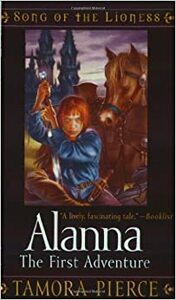
This is the story of Alanna who doesn't want the noble-lady life that’s expected of her. Instead, she swaps places with her brother and takes his place learning to become a knight. The story follows Alanna (or Alan) has she starts her journey to become a knight, while hiding her true identity from those around her.
I enjoyed the care taken into Alanna and her motivations - this idea of showing young girls they can do anything they set their minds to is good and I am always happy to see that in books. The story itself was interesting and took a few turns - I felt that Alanna (especially considering she is a child) is a bit OP at times and it feels like she can do things that adults can't and that did take me out of it. But seeing her work hard to improve in what she was bad at was a good touch.
There were a few things I didn't enjoy though:
This is the story of Alanna who doesn't want the noble-lady life that’s expected of her. Instead, she swaps places with her brother and takes his place learning to become a knight. The story follows Alanna (or Alan) has she starts her journey to become a knight, while hiding her true identity from those around her.
I enjoyed the care taken into Alanna and her motivations - this idea of showing young girls they can do anything they set their minds to is good and I am always happy to see that in books. The story itself was interesting and took a few turns - I felt that Alanna (especially considering she is a child) is a bit OP at times and it feels like she can do things that adults can't and that did take me out of it. But seeing her work hard to improve in what she was bad at was a good touch.
There were a few things I didn't enjoy though:
- The worldbuilding - I think this is a really interesting world, but i found it quite difficult at times to understand what was going on. I found the magic system quite confusing tbh.
There's talk about 'gifts' but no explanation about what they do. I understand that the gifts relate to magic but first we're told that the gods will punish those who don't use their gifts and then we hear of multiple people who don't use their gifts. We meet George and he tells us he has a gift, which is why he knew who they were, but we're also told that having a gift protects others from finding out things with their gifts. It was so confusing and I don't understand why there couldn't have been something explaining this. - The pacing - minor point, but it was confusing to see time pass in irregular ways. It was difficult to understand just how much time had passed, because it would feel like it had just been months from the text, but actually it had been years. Specific time markers ('finally winter arrived' or 'It was now Alanna's 13th birthday') were rare and spaced out.
- The Bazhir.
I don't think this was intended but I really didn't like how the Bazhir were portrayed. They're clearly Middle Eastern-coded, and the line about how they hide their women/wives. Jesus. The fact that everyone was like 'they're so weird' or 'I just don't like them' - I don't like perpetuating racist stereotypes, especially with no follow-up on that. Like fair enough if Alanna was like 'they're weird' but then learned more about their culture and said 'they're not weird now that i understand them' (obviously not exactly that but that meaning)
Content Warnings
Graphic: Bullying, Violence, Pandemic/Epidemic
Moderate: Child death, Racism
Minor: Death of parent
Sophomore year of high school. Strong female character.
Re-reading the tortall stories. This first instalment is much shorter than I remembered. The writing style is much more concise too. Still enjoyable, remains a 4